0727 933950 |
Info@embuni.ac.ke

- Home
- About Us
- Academics
- Admissions
- Library
- E-Learning
- Media
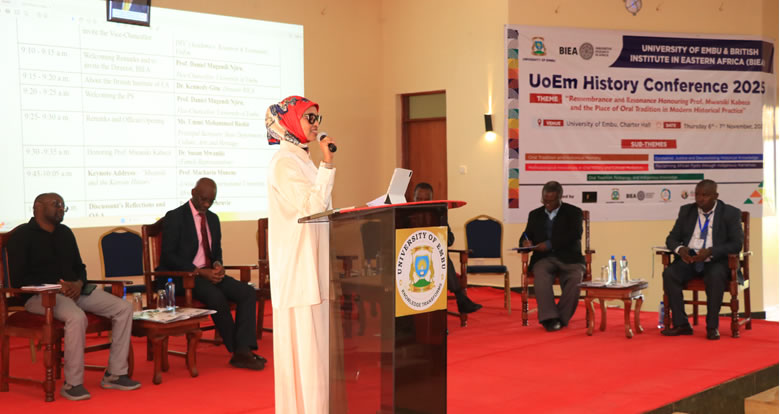
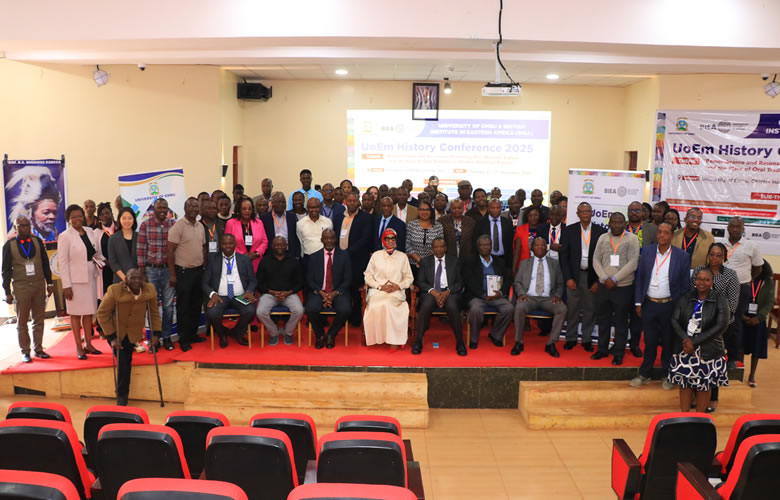
The University of Embu, in partnership with the British Institute in Eastern Africa (BIEA), the State Department for Culture, the Arts and Heritage and National Heroes Council, hosted a landmark History Conference on 6th –7th November 2025 at the University, themed: “Remembrance and Resonance: Honouring Prof. Henry Stanley Kabeca Mwaniki and the Place of Oral Tradition in Modern Historical Practice.”
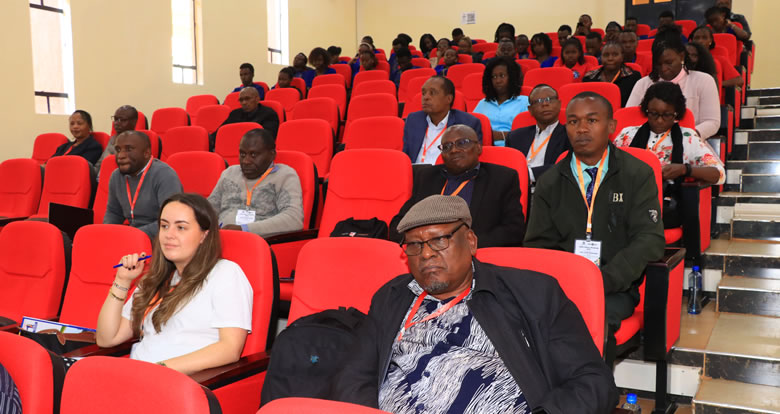
The two-day conference brought together over 160 historians, researchers, cultural practitioners, students, community elders, and senior government officials, to celebrate the life, scholarship, and enduring legacy of the late Prof. Henry Stanley Kabeca Mwaniki, a pioneer in the study of Kenya’s oral tradition.
The conference was officially opened by the Vice-Chancellor, Prof. Daniel Mugendi Njiru. He noted that the University of Embu provides an ideal environment for community-centred research. He described Prof. Mwaniki as “a guardian of memory and a bridge between generations,” and reaffirmed the University’s commitment to embedding oral traditions and indigenous knowledge systems in its academic and community engagement programmes.
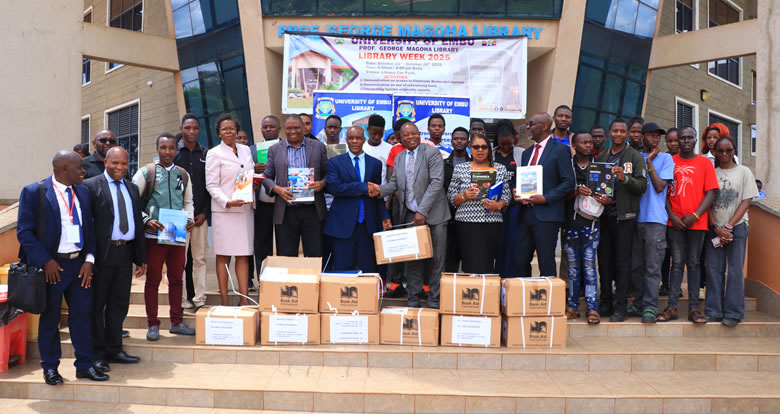
Speaking in this event, the Principal Secretary, State Department for Culture, the Arts and Heritage, Ms. Ummi Bashir, CBS, commended the University for championing the preservation of oral traditions. She underscored the ministry’s support for heritage scholarly initiatives and donated a collection of books to the University Library to strengthen cultural studies resources.
The Director, British Institute in Eastern Africa, Dr. Kennedy Gitu applauded the University of Embu’s leadership in advancing African-centred scholarship. He emphasised BIEA’s commitment to supporting research networks that connect community knowledge with academic inquiry, noting that the partnership reinforces Kenya’s role as a regional hub for historical and cultural research.
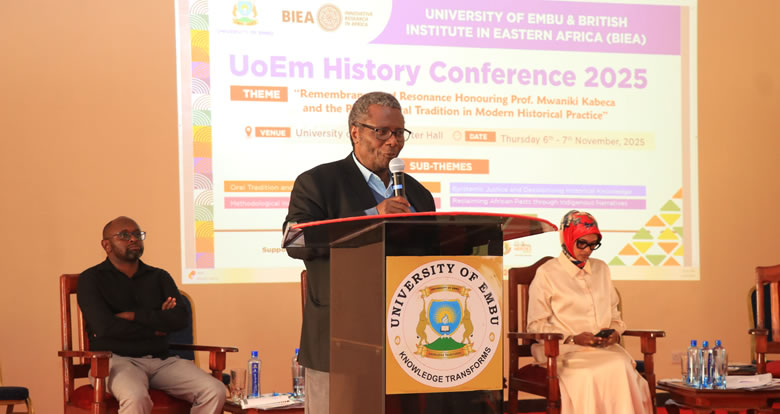
Prof. Macharia Munene form USIU–Africa, delivered a keynote titled “Mwaniki in Kenyan History.” He highlighted the value of oral traditions as the conscience of society and positioned Prof. Mwaniki among Kenya’s first generation of historians who advanced the decolonisation of historical thought.
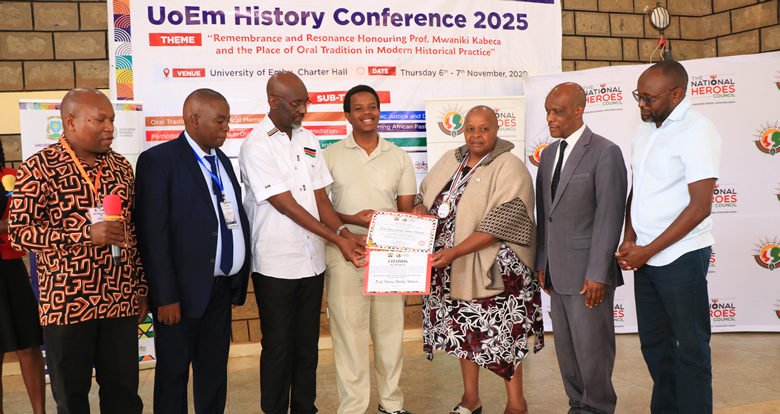
A defining highlight of the conference was the formal recognition of Prof. Mwaniki Kabeca as a National Hero by the National Heroes Council, in recognition of his outstanding contribution to scholarship, culture, and community service. Dr. Susan Mwaniki, speaking on behalf of the family of Prof. Mwaniki Kabeca, expressed deep gratitude to the University of Embu, the Heroes Council, and the State Department for Culture, the Arts and Heritage for recognising her father’s legacy.
Dr. Charles Wambia, CEO of the National Heroes Council, praised Mwaniki’s lifelong work in documenting indigenous knowledge, describing him as “a scholar who safeguarded Kenya’s soul through the power of memory.”
This honour aligns with the Kenya Heroes Act No. 5 of 2014, which recognises contributions in scholarship, culture, and community service as forms of national heroism.
Keynote addresses by leading scholars from the University of Embu, Egerton University, Kenyatta University, Karatina University, USIU- Africa, Tharaka University, and the University of Bristol were delivered. Other participants included independent researchers and community elders and national leaders reaffirmed the central role of oral traditions in shaping historical consciousness, nationhood, and inclusive public memory.
The academic programme featured six thematic panels and over forty presentations, exploring oral traditions, indigenous knowledge, decolonisation, methodology and digital heritage, alongside rich cultural performances that brought oral tradition to life.
The conference also strengthened institutional collaboration, with BIEA commending the University of Embu for positioning itself as a hub for African-centred historical scholarship. The event attracted wide national media attention, further affirming its intellectual and cultural significance.
Key outcomes of the conference include:
1. Development of a peer-reviewed commemorative publication
2. Establishment of a digital archive dedicated to Prof. Mwaniki’s works
3. Launch of an Annual Prof. Mwaniki Kabeca Memorial Lecture Series
4. Formation of Community Memory Circles with cultural elders
5. Integration of oral tradition and indigenous knowledge into university curricula
The University of Embu extends sincere appreciation to all partners, speakers, participants, and organizers whose collective effort made this conference a success.
In his closing remarks, Prof. Daniel Mugendi Njiru reaffirmed that the University of Embu will continue to be a home for research that bridges academic scholarship and community memory, creating knowledge that is relevant, inclusive, and transformative.